

How many Nobel Laureates does it take to light up an auditorium?
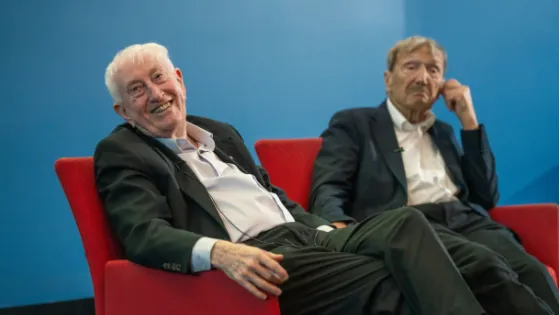
Above: Professor Peter Doherty and Professor Rolf Zinkernagel.
An opera singer, a vet and a vintner walked onto a stage.
It sounds like the start of a joke. Instead, what unfolded on the stage was a thoughtful discussion about curiosity, collaboration and the unpredictable path to scientific discovery.
“There are at least three things you need to succeed in science,” said Professor Rolf Zinkernagel AC, who joined Professor Peter Doherty AC and Professor Brian Schmidt AC FAA FRS for the public lecture. “One is a little bit of money. Second is intelligence. And third is an enormous amount of luck.”
Presented by The Australian National University in collaboration with the Embassy of Switzerland in Australia, the event brought together three Nobel Laureates in medicine and physics to explore the ideas, discoveries and experiences behind world-leading research.
Following the public lecture, JCSMR was fortunate to host a personal Q+A session with two of the Institute's ex-researchers (Prof Doherty and Prof Zinkernagel) chaired by Professor David Tscharke in the School's Finkel Theatre.
Above: Professor David Tscharke
For Professor Zinkernagel and Professor Doherty, the conversation was also a sort of reunion. The pair shared the 1996 Nobel Prize in Physiology or Medicine for discoveries concerning the specificity of cell-mediated immune defence. Work that began decades earlier at the ANU John Curtin School of Medical Research.
Luck wasn’t the only thing that first brought the two young scientists together. It was also Professor Zinkernagel’s passion for opera singing, which didn’t go over well with the rest of the faculty.
“The labs at the old John Curtin school were tiny,” said Professor Doherty. “Rolf sang, and that was one of the reasons they put him in the lab with me.”
Along with a shared appreciation for classical music, their different scientific backgrounds proved a successful pairing.
“I’m the only vet to ever have won a Nobel Prize,” said Professor Doherty, and “Rolf had some training in immunology”.
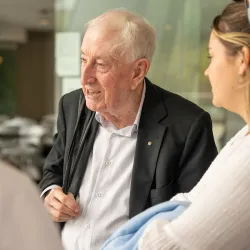
Above: Prof Peter Doherty, Nobel Prize recipient
In an era of just giving things a go, they combined their two skill sets and started experimenting quickly based on what they deemed to be “wild speculation”.
“We made a big discovery that was enormously exciting, and we worked incredibly hard,” said Professor Doherty.
“It was a finding that was completely new, and we found something that nobody was looking for, at least in the way that we did, which was to look at immunity to an infection.
“It's extremely gratifying when you're getting fantastic results and getting them quickly.”
Professor Zinkernagel added that “it's only possible to do that if you personally get along very well, have a similar sense of humour, or lack thereof. I think that helped enormously.”
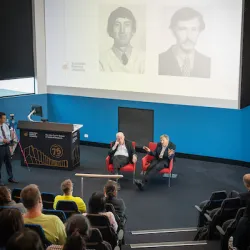
Above (Left to Right): Professor Rolf Zinkernagel and Professor Peter Doherty
For Professor Zinkernagel, the big questions are closer to home. “I think the biggest problem our human society has today is our longevity,” he said. “To keep one Alzheimer’s patient reasonably happy and healthy, you need two to three full-time employees.”
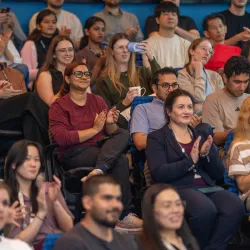
Above: Members of the John Curtin School of Medical Research
The John Curtin School of Medical Research community also had an opportunity talk to Professor Doherty and Professor Zinkernagel about their time at ANU.
“The time we were here was a fantastic time,” said Professor Doherty.
“It certainly revives old memories,” added Professor Zinkernagel. “This was a superb time for me with Peter together; life in science was much simpler. Very few people, even at that time, worked in infectious disease immunology, which even now is a very rare opportunity.”
During their frank discussion, in a much smaller auditorium than Llewellyn Hall, they emphasised the importance of loving your data, bringing simplicity back into experimentation, and writing early and often.
“To do science is great,” said Professor Zinkernagel. “Because one day you come home and you have understood something that nobody else has understood yet. And this is one of the best feelings to have.”